What the Brain holds
Open Brain from More, on the left. What the runs learned (the screens a browser reached, the findings, the simulated people and what they did, the claims your pages make, the Lab’s figures) sits beside what you told it: your settings and your own notes. Every fact says how it is known: measured, simulated, a model’s reading, or declared by you.
The Brain learns at the end of every run, for free. There is nothing to press.
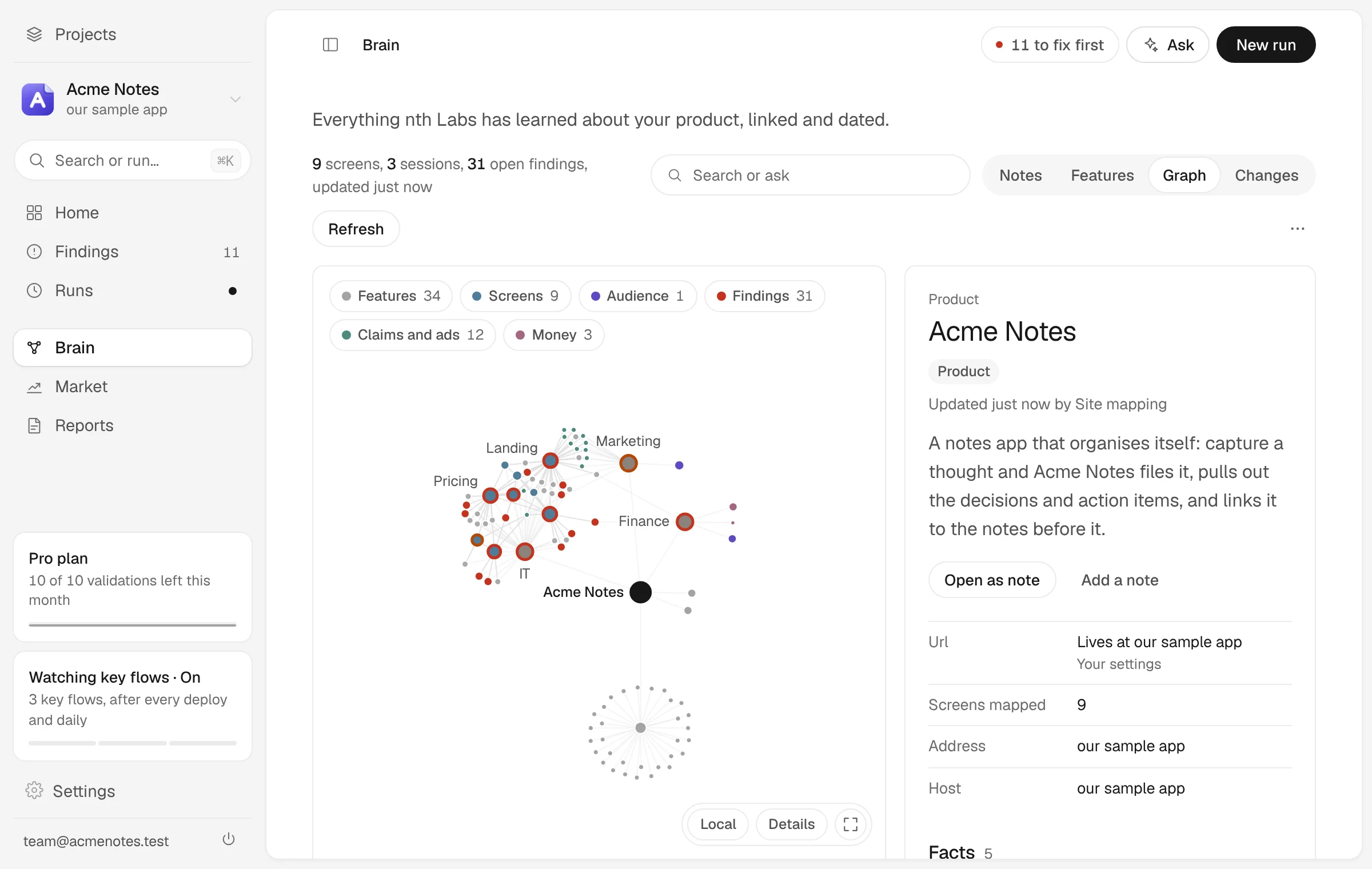
Reading it
The line at the top counts what the Brain holds (screens, sessions, open findings and notes of yours) and says when it last changed. Then choose a view:
- Notes: everything, one note at a time. Open a note to see what it links to and what links back to it.
- Graph: the same notes drawn as one picture of the product.
- Changes: what changed, and when.
Search or ask
Type in Search or ask, or press /, to find notes by what they say. Ask a question in words and a model answers from what the Brain holds, lists the notes the answer rests on, and labels the answer as a model’s, not a measurement. An answer in words needs a paid plan; without one, you get the notes that match.
Your own notes
Add a note to write down a decision, or something only you know, such as why a page works the way it does. A note links to the rest like any other, and your coding tool reads it when it asks the Brain for a briefing. Deleting a note takes it off the graph; the Brain keeps it in its history, with its dates, and never shows it as current again.
Refresh
Refresh rewrites the model’s reading of your product, what nth Labs understands it to be, from everything the Brain holds. That is one model call, so it needs a paid plan. The Brain itself does not depend on it.
Memory, and wiping it
Memory is what the runs taught nth Labs about using your product: which pages exist, which controls do nothing, and where testers gave up. Each new tester is briefed with it, so a later run pushes into what nobody has tried yet instead of checking again what is known. Memory details, in the … menu, shows what memory holds, how often it has been right going by your verdicts, and what the next tester will be told.
A memory of a product that no longer exists still briefs the next tester about screens and controls that are gone. Wipe memory, in the same menu, starts the next run from nothing. The Brain keeps what memory held as history, marked no longer current, and never deletes it.
Coverage
A clean result over three pages tells you nothing about the rest of the product. Coverage, on Home, shows how much of your product the runs reach: of the pages your front door links to, the share a run has driven. Measure coverage runs the Report, which is one of the free checks.
From your coding tool
Connected over MCP, a coding tool can search the Brain and read any note (labs_brain), get a briefing for the task in hand before it starts (labs_brain_context), and write a note or a decision into it (labs_brain_note) for you and the next agent to find. On console.nthlabs.dev, reading is on every plan and writing a note from a coding tool comes with Pro and above. See Claude, Codex, Cursor.
Export, and the command line
Export to Obsidian, in the … menu, downloads the whole Brain as a zip of Markdown notes. If you run nth Labs yourself, memory has its own command:
node cli.cjs memory
node cli.cjs memory reset     # when the product changes shape